


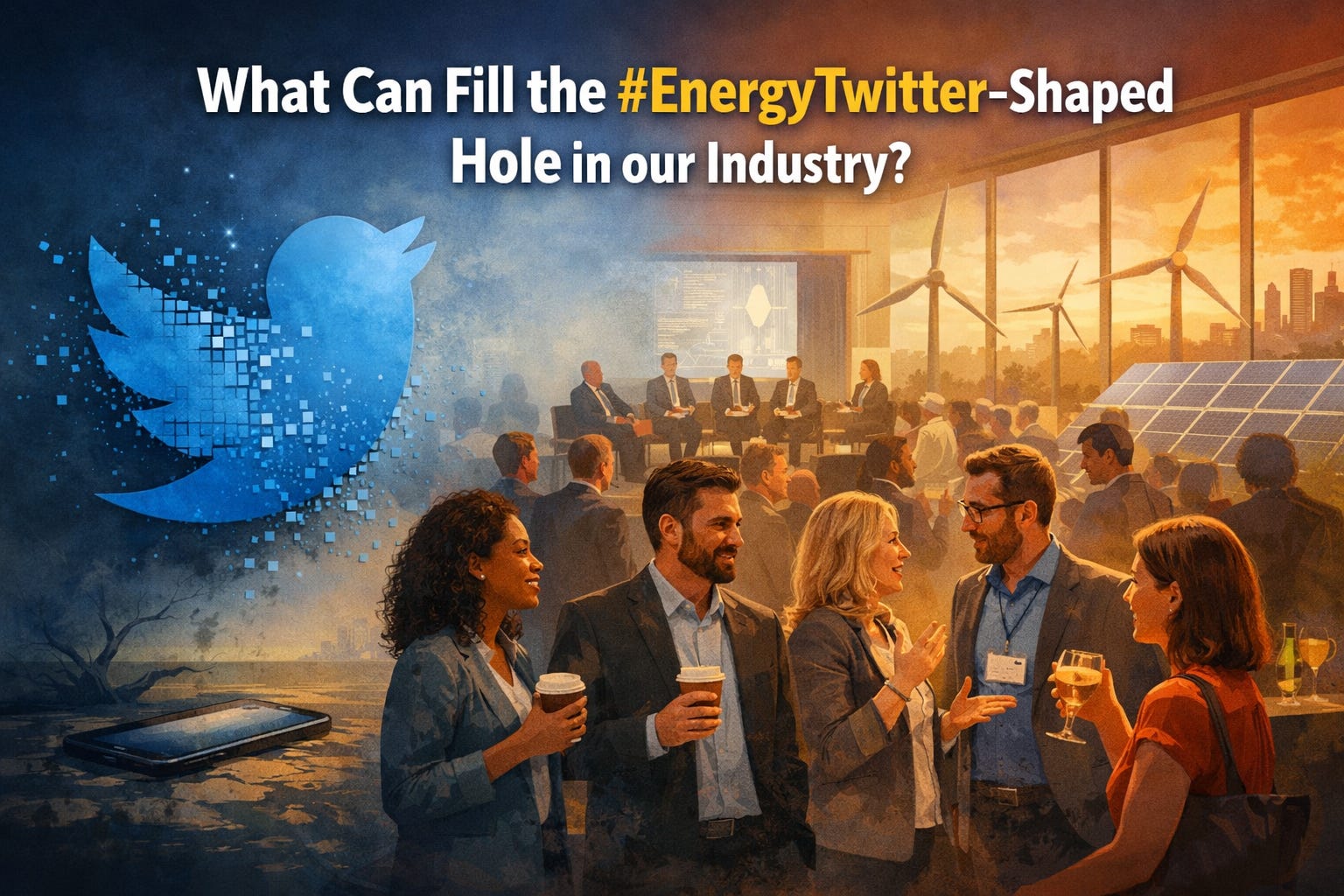
When I was in my late 20s, I started to feel a bit stagnant in my day-to-day energy career and decided to jump into the blog-o-sphere. I loved assigning myself topics to learn about, doing back-of-the-envelope analysis, diving down rabbit holes of research, and publishing pieces that ranged from serious reports on V2G to timely posts on politics, lighthearted looks at the holidays, or the odd intersection of two of my hobbies (fantasy football x energy, of course).
No matter what I wrote, the place where it all felt at home was what we all affectionately called #EnergyTwitter.
All the names I respected in energy policy, tech, consulting, and analysis were regulars there—Jigar Shah, Jesse Jenkins, Tyler Norris. Tag a post with #EnergyTwitter and you were suddenly in the conversation: instant feedback, reshares, debates, and introductions. It was a real, frictionless community, living and breathing.
So what happened? How come #EnergyTwitter nets nothing but crickets online these days?
My theory: It wasn’t on the energy pundits. It was on the platform. New ownership under Elon Musk meant major changes for Twitter—it shifted, misinformation proliferated, people fled (quickly).
And because #EnergyTwitter was a loose but passionate community—never a centralized monolith—when the crew split, the signal faded.
Some people tried to recreate the vibe on emerging platforms like Mastodon and Bluesky, others went back to LinkedIn. New formats entered the fray—video, newsletters, Discord servers. The problem? None of these replacements truly coalesced into the critical mass that #EnergyTwitter once was at its peak.
But I’m sensing a comeback. And it’s not happening on the platform we now reluctantly call X. I think the next #EnergyTwitter—the space where serendipitous introductions lead to speaking gigs, collaborations, and friendships; where ideas cross-pollinate throughout policy, tech, and ops—is going to happen IRL. #EnergyTwitter might just go analog, offering in-person connections to complement still-vital online tools.
Hear me out: I’ve been thinking about the separation between our curated online selves and our messy, full human selves since diving into Naomi Klein’s Doppelgänger this past holiday season. I’m reminded that online identity can feel like a mirror—sometimes useful, sometimes misleading—but inherently an incomplete stand-in for the real people behind the avatars, the memes, and the insights.
The antidote? Real conversations, face to face. In person, we can move beyond 10-second takes. We can trade deeper stories, mentorship, friendship, and context that laptops and feeds struggle to convey. We can recreate that #EnergyTwitter feeling of solving systemic, cross-disciplinary problems to build something even better.
Low-key happy hours, mentor circles, small-city meetups, and occasional deep-dive panels. And the big conferences, sure. Formats that mix quick, high-energy social time with a couple focused learning moments.
That’s what we’re going big on this year at Energy Central—getting people together, having smart conversations, then capturing and sharing highlights back to the broader online community…so we can all win from this new iteration of #EnergyTwitter. As they say online, more to come.
Have ideas about what might compel you to leave your home office and show up IRL? Share your ideas in the comments, or DM me if you want to help build this. #EnergyTwitter may feel like a ghost town, but maybe that’s because we’re all ready to step out from behind the screen and into the room.
—Matt