


Hey, everyone! Energy Central Editor Molly Glick here, taking over for Matt while he’s on parental leave. Excited to share some hot takes here on Substack in the coming weeks. Got any tips, feedback, or ideas? Hit reply and tell me what’s on your mind. Now…let’s dive in.
The event everyone’s been waiting for has finally arrived—and no, I’m not talking about the FERC show-cause orders.
Over the past month, teams and their fans from around the world have flocked to North America for the 23rd men’s FIFA World Cup. What makes this one special: It’s the first to feature 48 teams and three host countries.
As a New Yorker, I’ve noticed an endless stream of fans roaming sidewalks and subways throughout the city (if the jerseys weren’t a dead giveaway, the kilts definitely are). I can even hear the rowdy rumbles from soccer (er, football?) spectators at a nearby bar as I sit in my top-floor office.
I’m no sports person, admittedly, but I’m certainly a fan of energy analysis. So why not filter the tournament’s most promising contenders through a lens I understand far better than soccer?
With the help of some of my sports-loving colleagues, I’ve laid out the most hyped-up teams and paired them with spiritually equivalent energy sources. (If I’ve gotten the soccer analysis wrong, please direct your complaints to my coworkers.) Keep reading to find out how all those footballers and generation sources might fare in this year’s competition…and beyond.
Note: This is not a living document—after today, July 1, this article will not reflect current World Cup standings.
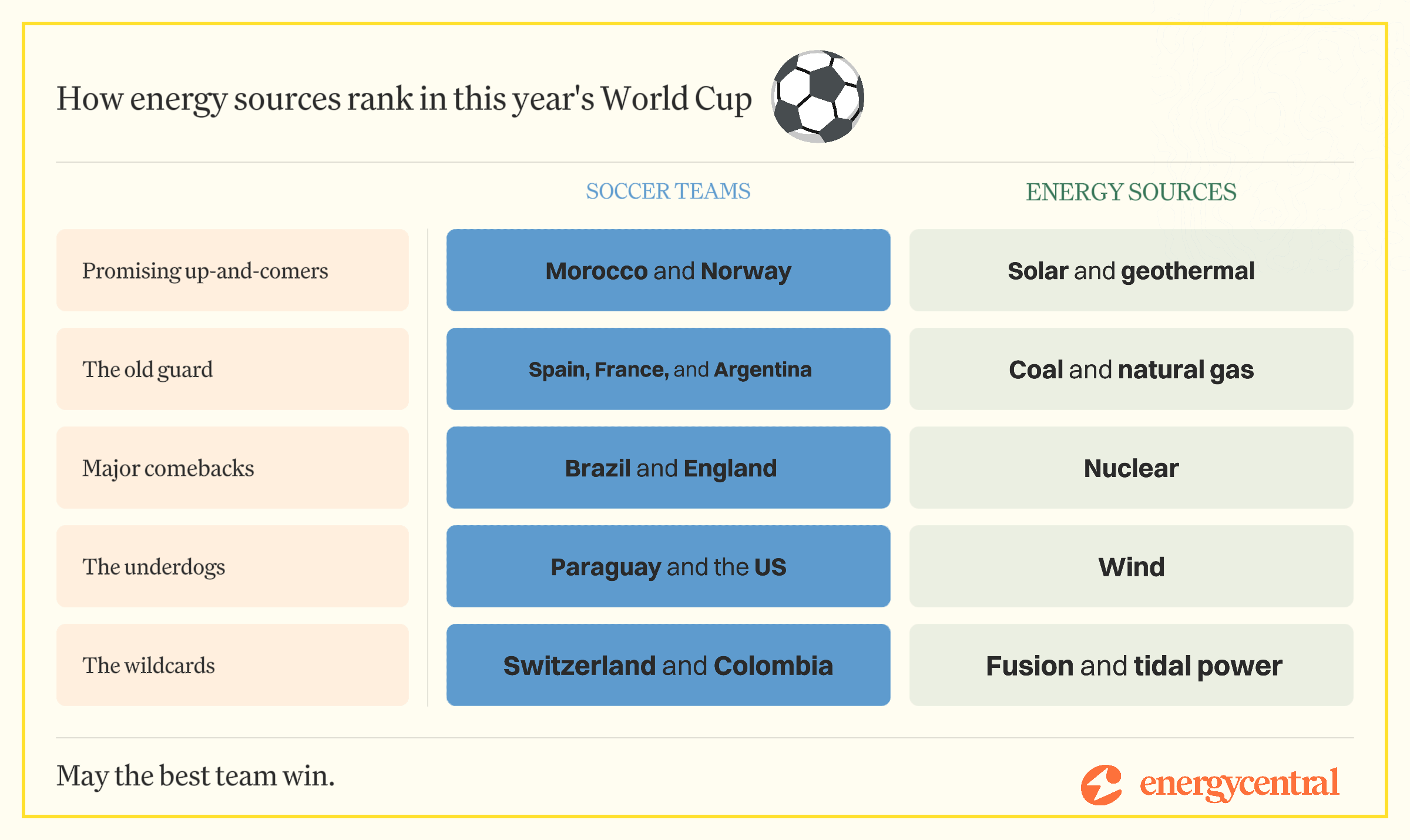
Promising up-and-comers
Morocco, which could become the first African nation to win the World Cup, is marking its seventh tournament appearance. The country has recently invested tons of resources into the sport, enabling top talent to reach the global stage. Norway, meanwhile, has returned to the World Cup after a nearly 30-year dry spell…and the fans are understandably rowdy.
Solar, as we know, has quickly climbed the US energy ranks over the past decade. In 2025, utility-scale solar generation reached 296K GWh (a 34% jump from 2024). Geothermal, meanwhile, has a ways to go: It only contributed about 0.4% of the country’s utility-scale electricity generation last year. But it’s receiving loads of investment from the private and public sectors alike, and it’s set to break into the once impossible Northeastern US market thanks to advanced geothermal tech.
The old guard
Spain, France, and Argentina have all appeared in the World Cup over a dozen times and racked up multiple wins. Of these competitors, Argentina has collected the most titles (three)—and took home the prize at the most recent tournament in 2022. The question now: Whether these teams still have what it takes. Will they rest on their laurels, shrink into the background, or remind the world why they’re dominant in the first place?
Coal served as the country’s main source of electricity for a century, but it offered just 15% of US supply last year. In fact, the domestic coal fleet has shrunk by 43% since its peak in 2010. Natural gas, meanwhile, is a far more recent heavy-hitter due to the shale revolution. Last year, natural gas ranked as the top source (roughly 41%) of US utility-scale electricity generation.
Major comebacks
While Brazil has won more World Cups than any other national team, it hasn’t notched a win since 2002. England, meanwhile, hasn’t reigned as champion since 1966…but it has come close several times since.
Nuclear had a great US run until the 1970s, when costs and construction delays began to pile up (along with high-profile accidents). But nuclear is now all the rage again, and the Trump administration is pushing fission to help satisfy mounting data center demand.
The underdogs
This week, Paraguay shocked the world by beating Germany—the men’s team with the second-most World Cup titles of all time (to celebrate, the country declared a national holiday). And the US qualified for every World Cup from 1990–2014, but it’s had a spotty record since.
Wind has had a tough year, to say the least, thanks to all those Trump administration-brokered lease buyouts (which have totaled over $2.5B) and stalled permitting reviews. But some projects have powered through the opposition, including the country’s largest of its kind: The 2.6-GW Coastal Virginia Offshore Wind project began spinning out power in March.
The wildcards
Switzerland has never won a World Cup, yet the team has now appeared in the championship six times in a row. (But the country hasn’t made it to the quarter-finals since 1954). And Colombia is returning for its seventh tournament after failing to qualify in 2022. Right now, the nation has somewhat decent odds of moving up the ranks.
Fusion and tidal power could both generate massive amounts of electricity. The former, if it pans out, might churn out nearly 4 million times more energy than burning oil or coal. Tidal power, which is already commercially proven at a few plants around the world, has the potential to generate 150 to 800 TWh per year. But it’s super costly and has a limited supply chain (for now, at least).
Which teams will win the World Cup?
This, of course, depends on who you ask. According to Ben Church, international sports writer at CNN, “It’s very unlikely for there to be an upset at the World Cup. There’s just too many quality teams for an underdog to go all the way.” Church’s bets are, unsurprisingly, on a top contender like France, Argentina, Spain, Brazil, or England.
At the time of writing this Substack, I noticed that The Athletic and ESPN (along with Polymarket and FanDuel) favored France.
Still, as with energy, you never know what might happen. We could see one of the favored teams suffer a sudden upset, as with Germany’s recent loss. An underdog could hold its own in the knockouts, which are now running through July 19, and end up in the final match. “That’s the beauty of a cup competition,” Church said.
Which energy sources will dominate the world’s electricity supply?
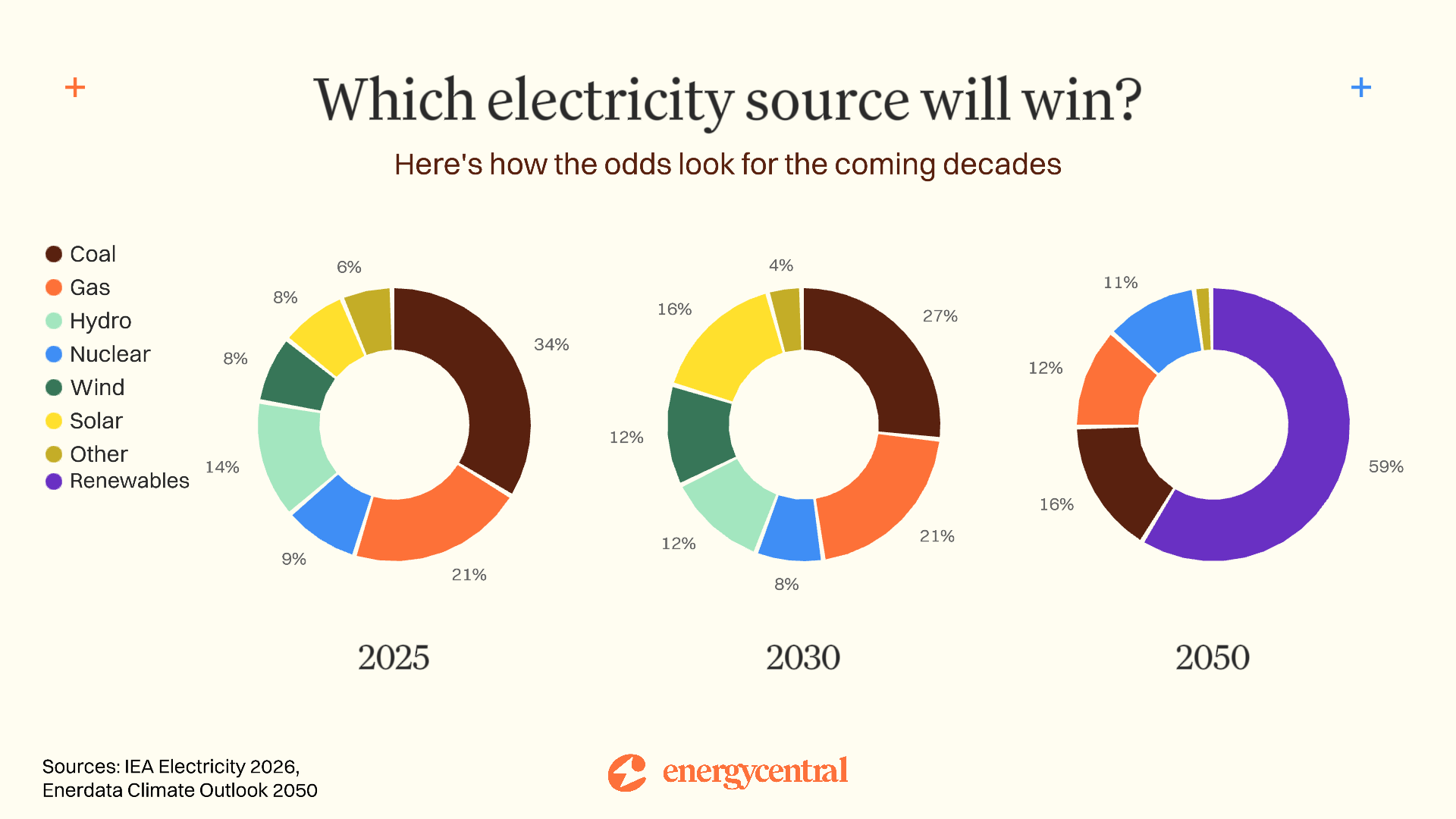
Unlike soccer tournaments, energy moves in decades—not weeks. So I decided to pit these sources against each other over two timeframes: by 2030 and 2050.
By 2030: Based on current trends, the IEA sees coal- and gas-derived power continuing to dominate globally. But at the same time, the agency expects wind and solar to contribute a growing chunk of the world’s electricity (this isn’t surprising, given the recent monthly records broken by solar and wind).
By 2050: It’s looking like more of a crapshoot—so many factors, including more stringent carbon laws in wealthy nations—could influence this outcome. In Enerdata’s business-as-usual scenario, for example, renewables dominate generation globally…but coal still clinches a 16% share.
The bottom line? I think the soccer and energy worlds have a few key similarities:
A reliable reputation goes far.
Investment and devoted fans are key to success.
The tournament (and energy mix) of today could look completely different from a few decades ago.
Sometimes, the world order gets shaken up when old favorites fall…and young talent rises up the ranks.
Now, I’m feeling especially psyched to see which teams conquer the world stage (literally and figuratively). I’ll keep cheering from the sidelines…and telling everyone where their favorite teams stand in the energy world.
Love this-- combining the sports and energy lens is a winner in my book. Why it's interesting in this context: a tournament is a natural zero sum game. If your team wins, that means that the best my team can do is second place.
Similarly with the grid, while demand is EXPLODING these days, it still remains that there's a finite appetite for MWh and different power sources are competing to fill those needs in the most affordable and reliable manner. The difference, though, is we can see complimentary sources of power (e.g., solar being a great source, but needing a buddy that complements the duck curve). But as I sit here waiting for the U.S. match to start, I'm not thinking about how Bosnia-Herzegovina will 'complement' our game-- I'm thinking about how we'll win!
But perhaps that's too often the American way of thinking when it comes to energy, too (American Energy Dominance rather than being a collaborative player with partner countries)?....now I'm just talking myself into a thesis for a substack post of my own :)
Thanks Matt! So many sports and grid similarities…but at least, as you say, power sources can work together! I’m excited to see your next Substack ideas when you’re back.