


In popular media coverage, energy stories are often influenced as much by headline grabbiness as actual industry movement. The headlines yell at us:
Nuclear is back!
Geothermal is hot!
Coal is killing you!
But how much of these stories are actually rooted in true developments? Grid planners can’t keep the lights on based on what stories happen to be trending.
I’m often surprised when a friend who isn’t in energy reaches out to ask about an exciting-sounding (but not entirely relevant) tech they just read about (Can’t hydrogen solve this all? What about gravitational energy storage?). But it makes sense: Those not entrenched in the daily developments are much more likely to open a push notification on shiny new tech than they are, say, to engage with the fact that a run-of-the-mill gas plant is being built in their state.
To measure this apparent gap between popular media coverage and reality, I’m donning my engineer hat and busting out the energy drink that got me through college statistics classes. Specifically, I decided to compare Google Trends results against plant capacity changes over time (with the help of EIA’s monthly electric generator inventory) for eight key power sources. Does popular attention coincide with the opening and closing of power plants?
What does the data say?
The investigation comes with a lot of variables to map: Eight different power sources over 16 years, tracking a) capacity added, b) capacity closed, and c) relative Google Trend rating for each of those combinations. My fellow data nerds can see the table of exact numbers here. Everyone else can just check out the resultant graph below.
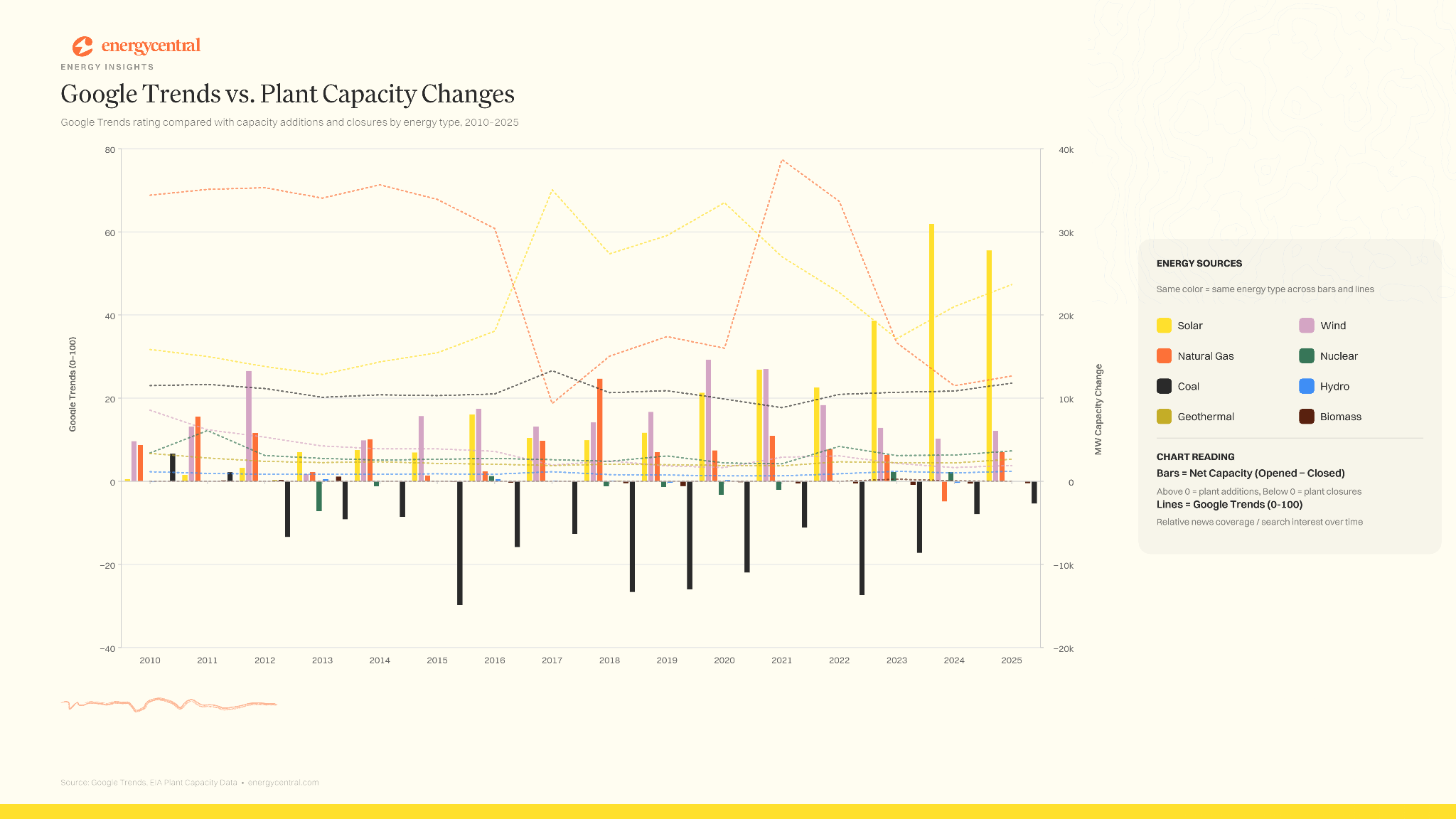
This chart has much to digest, but some compelling trends pop out:
Solar was hyped up for much of the coverage period, but capacity only really ramped up in the latter years.
The 2010s was a huge decade for solar reaching maturity, and that piqued our collective search interest. But these developments didn’t translate to massive installations until the 2020s, once falling costs were boosted by favorable policies.
Wind is the silent needle-mover, adding consistently high capacity without dominating search,
Google searches represent an inherent ‘how does this affect me’ mindset, with rooftop solar and large power plants often at the forefront. But people don’t often encounter wind farms due to their typically remote locations, so relatively fewer people feel compelled to learn more. And while we hear a lot about high-profile wind projects announcements (or cancellations), it doesn’t appear to reach the same fever-pitch hype.
Nuclear is rarely added to the grid, and attention thus remains lower than expected.
We only see three individual years with new nuclear capacity. So while the industry is buzzing about nuclear possibilities, the public attention is evidently as slow as the additions to the power mix. The one year that saw a relative spike in nuclear attention was 2011 in the wake of the Fukushima disaster (not a reason the nuclear industry wants to drive traffic).
Geothermal only added a fraction of nuclear’s capacity, but attention was comparable between the two.
Nuclear actually ends up with comparable search interest to geothermal energy, though geothermal only added a third of the capacity. Perhaps geothermal is seen as the most agreeable renewable: no fuel; highly dispatchable; no critical minerals needed (all reasons geothermal is seeing a surge of interest under the Trump Administration, the rare support of a renewable energy tech).
The two least-searched sources: hydropower and biomass, though not equally ignored.
Civilizations have run on some form of hydropower and biomass for centuries or more. But why does hydropower register slightly on the scale, while biomass is largely ignored? I’d posit that biomass is just less sexy: landfill- and sewer waste-fueled projects are great sustainability solutions, but they’re…not appealing to think about.
Powering the grid today vs. the future
Of course, capacity added doesn’t directly correlate with what’s powering the grid (I’ve previously covered this). But the main sources of electricity generation today (gas, nuclear, coal) aren’t exactly turning heads—people aren’t as likely to search out that nuclear power plant that’s been operating safely for 30 years. They’re far more interested in what might come next.
What does this all mean?
A couple main takeaways:
Public perception is valuable, but it has its limits: People get excited by possibility—but it can take years for hype to translate into real grid impacts. Reading past the headline is important: We need to look at what the data is actually saying, which should inform our worldview and decision-making. (Also: Never underestimate the special interest groups pushing narratives or the power of clickbait in dictating headlines).
Sometimes the hype is real, but early: Take nuclear—a lot of today’s attention is tied up in technologies like SMRs or even fusion, both of which are still years away. That doesn’t mean the excitement is misplaced, but it does mean we’re often talking about future potential rather than present-day impact.
Boring =/= not valuable: On the flip side, when something like wind is steadily adding capacity without dominating the conversation, it’s a reminder that some of the most important parts of the grid keep on building without the same level of fanfare.
Disconnect between hype and action could warrant analysis: We want to resist the temptation to evaluate the energy transition based on vibes alone. But if the numbers don’t line up with the narrative, that’s where things get interesting. Take the early 2010s hype on solar that was slow to translate to capacity figures. Is it a policy bottleneck? A funding gap? A public awareness issue? Or just the natural lag between innovation and infrastructure? Those are the questions worth asking.
Tech maturity isn’t what drives attention: Sure, we’re still talking about natural gas and nuclear—long-established pillars of the grid. But solar has managed to sustain attention both before and after its major growth phase, all suggesting that buzz isn’t just about what’s new versus what’s proven. It’s about what captures the narrative.
Because in the end, narrative matters. It shapes what people care about, what policymakers prioritize, and where capital flows. It doesn’t always align with reality—but it absolutely influences it. If we want to understand where the energy industry is going, we can’t just track what’s being built. We also have to pay attention to what’s being talked about…and remain clear-eyed about the gap between the two.
you've been doing some really interesting thinking this year, Matt. keep up the terrific work.
Very nice analysis Matt. One good thing about the President: He keeps energy in the news. It will be interesting to see where the trends lead post Iran war, 5-10 years from now. Some commenters (e.g. Krugman) have pointed out the irony of Trump's insane aversion to renewables and his Iran war forcing some countries to realize the tenuous supply chain issues of oil. They predict that we will see an inflection point in 2026 indicating faster interest and adoption of non-fossil fuel energy.
Even the OPEC states seem to be anticipating the pivot and are trying (desperately?) to diversify their economies.
I'll look forward to the day, not far in the future, when former Maga-Republicans try to claim that it was their intention all along to wake-up the world to the strategic foolishness of relying on oil!
Of course, the Trump era will seem like a very bad dream by then.
As my Father used to say: "I should live that long!"