


There’s a chapter in Neil deGrasse Tyson’s Starry Messenger about how humans love predicting the future but are spectacularly bad at doing so. The 20th century was full of arrogant, futuristic declarations that turned out to be—politely put—optimistic. It wasn’t uncommon to be both loud and wrong, as it turns out.
So what can we, as an industry predicated on thoughtful future-casting, do to avoid that same fate? When the IEA, the EIA, or any of the rest of the alphabet soup publish a model, you’ll hear kneejerk reactions. Stakeholders on every side rush to use numbers to justify their story, whether that’s that wind will save us, nuclear is the only sensible route, fossil fuels are forever, etc. Do we want to be loud and wrong again?
I sure don’t. So I was inspired to look backward. What did voices of the past confidently predict about energy, and what actually happened? I dug into the history books and walked away with some clear patterns and practical takeaways. Here’s what I learned, starting with the boldest predictions. ➡️
1) “All petroleum will be exhausted by 1939.” (1909 USGS warning)
A dramatic 1909 press account of USGS predictions dug up by Paleofuture warned of petroleum exhaustion by the 1930s.
Reality: Oil scarcity predictions have repeatedly been pushed out as new fields emerge, recovery techniques improve, and technologies evolve. Rather than running out, markets and technology delivered more accessible oil for many decades with reserves continually growing.
2) Methane from algae will replace gas by 2020. (1974)
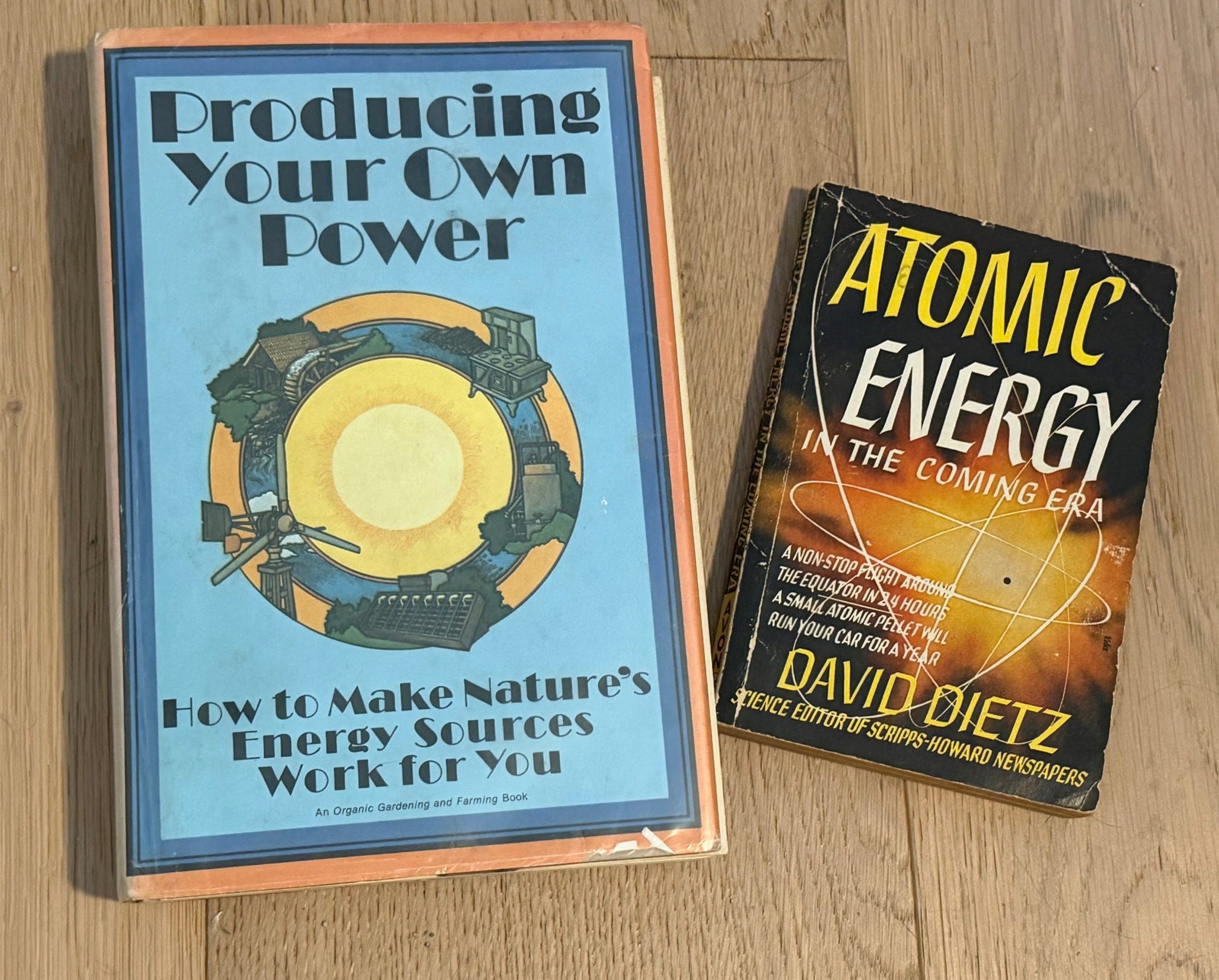
I have a couple decades-old books in my personal library from used book stores—they feel like windows into the past. For example, Producing Your Own Power (1974) projected that algae-fed digesters could “produce as much as 100 percent of our gas needs by the year 2020.”
Reality: Not even close. Biogas and biomethane have grown, but they amounted to a tiny sliver of global gas supply in 2020. IEA scenarios show biogases rising from ~1% today toward a few percent by mid-century.
3) Solar will solve everything—in five years. (1979)
Paleofuture reproduces a 1979 New York Times poll: 42% of Americans thought solar could solve our energy problems in five years.
Reality: not quite. Solar generation remained niche (at best) through 2000. Growth did accelerate, but only later (mid 2010s to 2020s). In recent years, solar has grown explosively, contributing nearly 7% of global electricity by 2024, but everything is far from solved.
4) Fusion will be on Earth by 2010. (1984)
A 1984 caption reproduced by Paleofuture imagined fusion’s “first uses…on earth, perhaps by the decade of 2010.”
Reality: Fusion remains promising but long-term. Turns out, it’s still more of a moonshot this century than our forebears expected.
Patterns that emerge
Why does this overconfidence remain ubiquitous over the decades? Three main reasons jump out:
Wishful acceleration—people often assume best-case R&D breakthroughs will continue unchanged, but technologies hit countless practical bottlenecks.
Category errors—confusing scientific demonstration with deployable infrastructure creates overly optimistic takes, no matter how much we want tech to scale to commercialization.
Underestimating human systems—markets, regulations, and politics matter, meaning even brilliant tech can stall for social and institutional reasons.
Are we any better at forecasting today?
But those were the overly optimistic people of the past, surely we won’t replicate their shortsightedness!
I wouldn’t be so sure.
Prediction markets like Metaculus capture crowd beliefs and give us calibrated probabilities for specific milestones. A few current Metaculus energy questions show where attention sits:
“When will nuclear fusion provide >10% of the world’s primary energy?”—June 2073
“Will solar power on Earth dominate renewable energy consumption before 2031?”—86% chance.
“Will data centers consume more than 10% of global electricity usage for the year 2030?” —23% chance.
These crowd forecasts are more useful: They attach calibrated uncertainty to specific claims and they’re often looking at nearer-term deadlines. Metaculus is not a crystal ball, but it’s a cleaned-up way to ask, “If we all had to put money on it, what would we say?”
So what’s the practical takeaway?
This exercise highlights a few key takeaways for those trying to predict the future of energy:
Be humble, not nihilistic.
Separate lab wins from deployment realities.
Bias toward systems thinking.
I’ll close with a passage from my dusty bookshelf and the 1945 piece Atomic Energy in the Coming Era, in which Einstein is quoted on the impact of the dawning nuclear age:
“‘Why does this magnificent applied science which saves work and makes life easier, bring us so little happiness?’ he said. ‘The simple answer is: Because we have not yet learned to make sensible use of it. It is not enough that you should understand about applied science, in order that your work may increase man’s blessings. Concern for the man himself and his fate must always form the chief interest of all technical endeavors’...
The scientist realizes how very young scientific knowledge is… The use of atomic energy is only a few months old. Less than 500 years have elapsed since the days of Copernicus. It is less than 400 years since Galileo first turned his little telescope upon the heavens. The modern atomic theory is less than 150 years old. It is less than 50 years since man learned of the X-rays, of radium, and the electron. The use of atomic energy is only a few months old.”
Forecasts are about data inputs, but they are also about people. If we treat projections as tools to inform wise collective choices rather than certainties to be wielded as tribal proof, we’ll do better.
So let’s channel a little of Tyson’s healthy skepticism, a lot of Einstein’s perspective, and a steady dose of institutional humility. Forecasts matter. They shape investment and policy. But they’re hypotheses, not scripture.
Great article, and a message we would be wise to heed. I long ago stopped putting much credence in forecasts, particularly those generated by government entities.
Peak oil, no peak oil
Coal decline, oh wait, not yet.
Green hydrogen, fusion, etc.
The latest absurd exercise is attempting to forecast the power demand form data centers. I strongly suspect - actually I'm certain - that all the forecasts are in error on the high side because as usual, they ignore the myriad challenges in building out infrastructure.
I loved this comment "We are often spectacularly confident—and reliably wrong. Today, we have plenty to learn from these failed forecasts" and appreciated your looking back to forecasts. The only thing to say this os not only energy, take Computers, Technology, Transportation and each failed to get many things right but it seems to me the Gartner Hype Curve is universal- in its four stages, the only difficulty is knowing when we pass from one to the other. I support "we do when we do" is the best prediction