


Recently, power industry decision-making has gotten pulled into the ever-growing vortex of politicization. But in an increasingly divided country, it’s not exactly surprising.
Renewables vs. fossil fuels. An energy transition vs. American Energy Dominance. Beautiful Clean Coal vs. Climate Emergency.
This trend of everything being labeled as red vs. blue is, simply put, exhausting.
When everything gets pulled into a partisan lens, debates get painted with overly broad (arguably lazy) strokes.
Sure, politics in energy is nothing new—just look at the yo-yoing history of solar panels on the White House roof. But recently we’re seeing energy policy debates sink further into the low-hanging fruit of identity politics.
As a counterpoint, I thought it’d be helpful to identify some notable examples where the cold, hard data of energy can dispel red vs. blue state assumptions, encouraging us all to think more deeply than the partisanship of it all:
Myth #1: RED STATES steer away from renewables
If renewables are the domain of people who back a Green New Deal, then surely red state grids ignore renewables.
Renewable penetration, though, doesn’t abide by partisan-colored glasses. Looking at the 2025 power generation data, red states1 are among the national leaders:
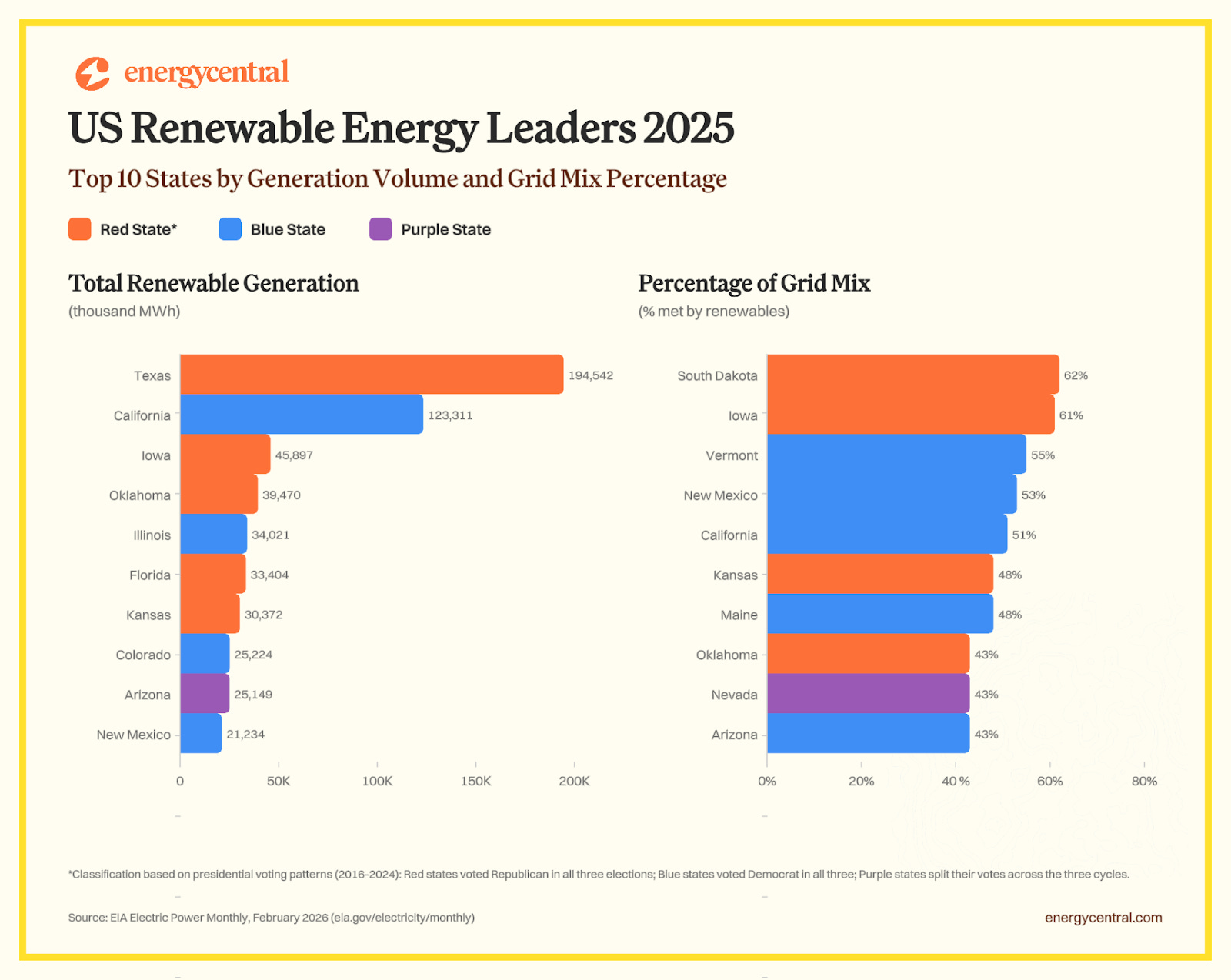
Renewables in these states can thank abundant wind resources in Middle America and the Sunshine State’s namesake solar power, as well as some pro-renewable policies like the Kansas Renewable Energy Standard and Competitive Renewable Energy Zones in Texas.
Myth #2: Coal continues to have a presence because of strong RED STATE support.
Coal is a political lightning rod: We often think Democrats are more likely to support closing these carbon-emitting plants, and Republicans will support existing coal plants in the name of reliability renewables can’t deliver.
Does the data support that distinction?
Looking at coal plants closed since 2023, 60% of shuttered coal capacity came from red states:
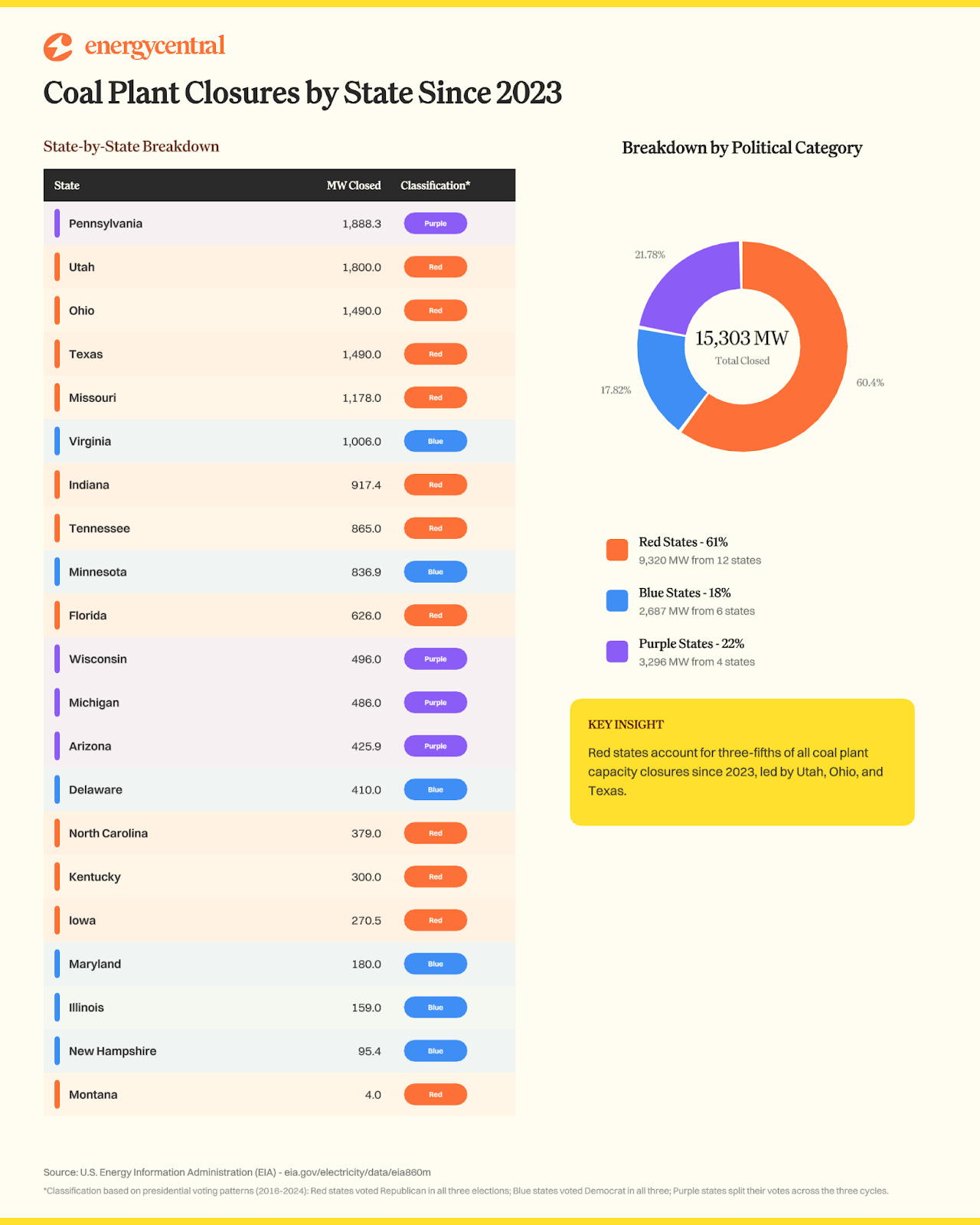
Going back further in time only highlights further that more coal plant closures have come in red states over the years. True, this fact simply highlights that red states built more coal generation initially and so there were more megawatts to be retired, but it also flags that being a reliably red state is not enough to keep coal plants open.
Myth #3: When it comes to economics, BLUE STATES are regulation hawks
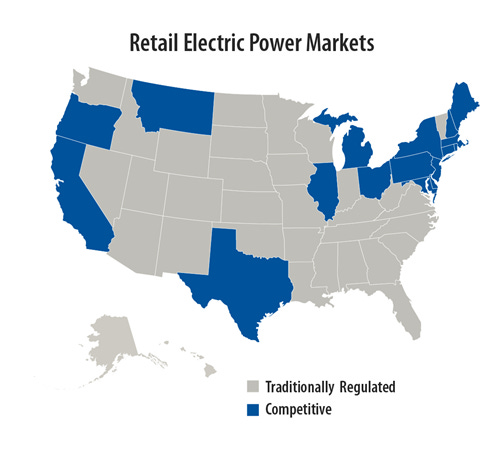
Among other services, energy is unique—most regions treat utilities as a protected monopoly. But for a small slice of the U.S. power sector, retail markets allow a degree of customer choice.
Conventional politics would suggest blue states would be the ones to favor regulation, while red states would prioritize free markets. The reality, though, disagrees: retail electric power markets exist in 12 blue states vs two red states (and two purple states). So maybe the free market isn’t the exclusive domain of the political right, after all.
Myth #4: RED STATES are the ones shifting the grid to baseload gas
Regardless of politics, coal plant closures have transformed every state’s power mix in recent years. And perception would suggest that blue states are replacing coal with renewables, while red states lean towards gas.
Looking at the use of natural gas by state, though, tells a slightly different story: Of the 10 states using the most electricity from natural gas, three are blue (New York, California, and Virginia) and one is purple (Pennsylvania).
Just over half of these gas-leading states are red—but that certainly does not indicate a monopoly on gas support by Republican-leaning regions.
Myth #5: BLUE STATES reject nuclear
Listening to the rhetoric, you would think that blue states would be renewables or bust. But it’s not always renewables vs. fossil fuels. Nuclear can provide baseload power, too, but without the carbon emissions.
Environmental and safety concerns have long presented an uphill battle for nuclear, which might be most expected in the tree-hugging blue states. But the data tell a different story:
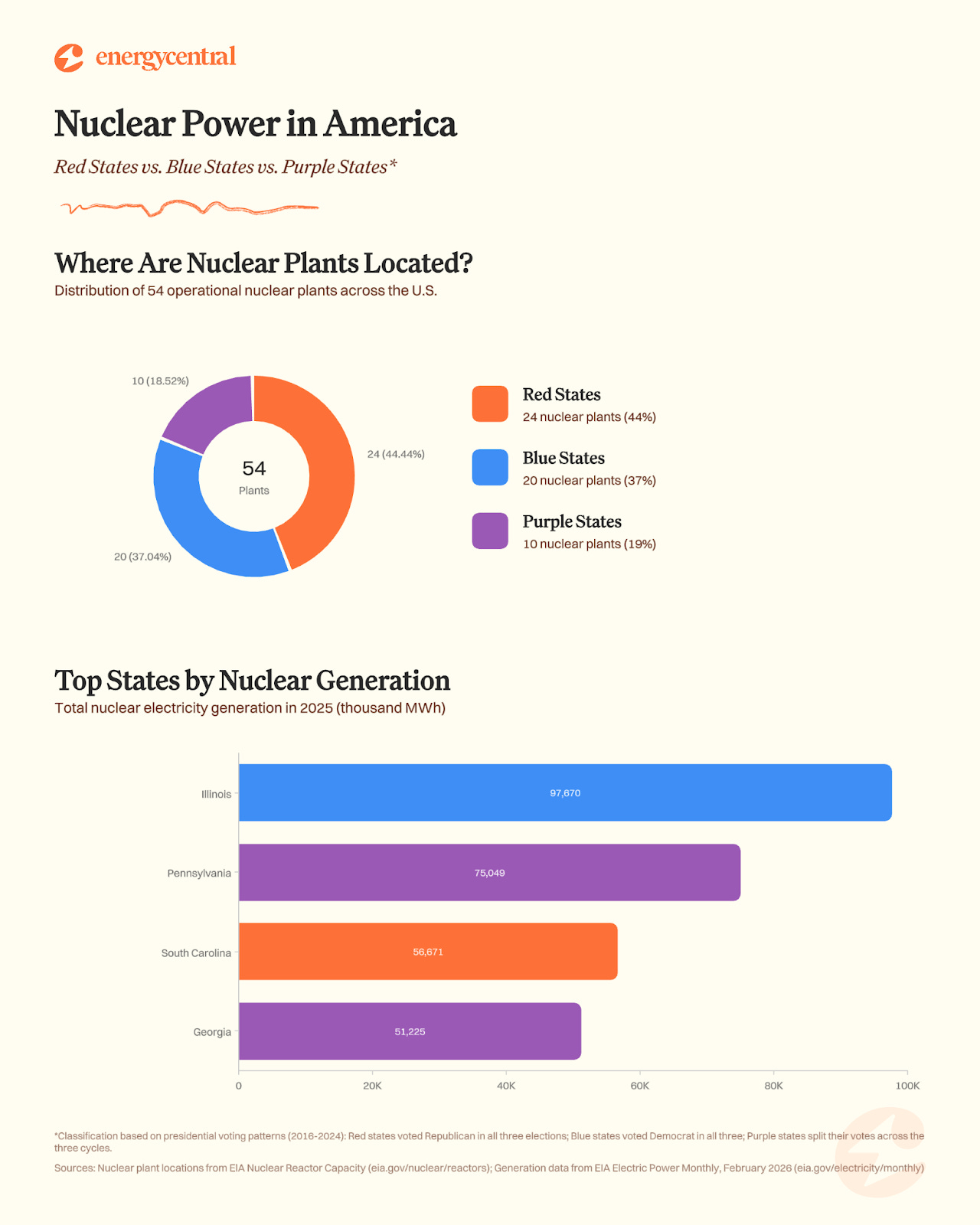
Nuclear power adoption, it seems, is poorly predicted by state policy trends. Perhaps nuclear’s carbon-free baseload generation offers a bipartisan win (provided you can overcome the pushback from groups that lean to both sides of the aisle).
Myth #6: Electric Vehicles aren’t actually popular outside of BLUE STATES
Environmentalism may have been a major push for early EV adopters, so many people would assume that the vehicles are deployed in more green-minded blue states.
However, the states with the most public-facing EV chargers include two of the more prominent red states, Florida (with the country’s third-most EV chargers) and Texas (fifth-most).
What’s with all the EV-driving in these states that may evoke the red side of political culture wars?
1) They have high populations, so even lower adoptions rates require more chargers.
2) EV performance can struggle in cold weather, but buyers in warm states may hear better feedback from Tesla-driving neighbors.
Myth #7: These days, only a RED STATE would invest heavily in oil drilling
After all, these are the regions where policy would support drilling for fossil fuel.
But as of 2025, the data show that the top 10 oil-producing states include blue stalwarts Colorado and California. Perhaps decisions of whether to drill are dictated more by the presence of fuel underground and the economic benefits that come with accessing them…so even environmentally conscious states feel the pull.
Even when the trends follow your general expectations, that doesn’t mean any one of these political-to-energy associations is right or wrong. Instead, it means all assumptions warrant investigation into the nuance, identifying why each region may look the way it does in terms of energy.
Such zooming in also highlights how inane it is to just brush any policy debates off as purely red state vs. blue state. Most states with such labels are more divided than we are led to believe: In Florida, for example, 38% of voters registered as Republicans and 31% as Democrats. That gap is smaller than a single color label would suggest.
But most importantly, these counterexamples highlight that partisanship is just one factor in a very long list of influences to a region’s energy outcomes. Whether it’s Florida being more inclined to see EVs on the roads or California wanting to cash in on its oil resources, characteristics like geography, history, demographics, and economics tell a truer story than ever-shifting (and often oversimplified) partisan identities.
In this article, I will be using an overly broad metric of considering a state red vs. blue based on if they voted for the same party in at least the last three Presidential elections, as found in this USAFacts database. This metric suffers from the same oversimplification as I’m pointing out people take in political debates– is that a feature or a bug in me trying to make a point in this article? You tell me!
Comment reposted (with permission) from Llewellyn King:
I think you're so right in drawing attention to the politicization of various technologies. I took up this issue decades ago when rued the fact that conservatives favored nuclear as an act of faith and as much as an act of faith, liberals hated nuclear.
Now we are seeing it again with the absurd rejection of wind in favor of coal. A tool is a tool. Again, you are right: utilities cannot plan against political whim.
I just want you to know that I wholeheartedly agree with you.
On another matter: you are right also to raise the issue of salaries for the heads, often tituler, of investor owned utilities. They are overpaid and make it harder for the public utilities to attract and keep talent.
Matt - this is excellent. A few other data points (and please correct me if I’m off base) in addition to your on-point observations about the myth/reality points on generation by state.
1. The current administration paid a European firm ~$1B to terminate offshore wind projects in the eastern US. The Sec of Interior claimed when announcing this that offshore wind is “one of the most expensive, unreliable, environmentally disruptive, and subsidy-dependent…” forms of generation.
2. The DOE has, seemingly in direct contradiction to the administration’s wishes, continued funding billions in loans for generation and transmission.
3. Red-state-coded talking points on renewables, blaming failures in the Texas grid following bitter cold several years ago, has not appeared to change that state’s direction—continuing aggressive expansion of renewable generation.
While these are, perhaps, disparate anecdotes, they call to my mind the same gap you identified in this article between surface-level politics and the realities of an approximately free market operating in the context of changing incentives set by see-sawing leadership at the federal level.